Timber or composite? It’s one of the first decisions most homeowners face when planning a new deck.
There isn’t one answer that suits every home.
The better question is: which decking material best suits how you want to use the space, how much maintenance you’re prepared to do, the conditions around your home and the look you want to achieve?
At Proline, we work with both timber and manufactured decking. Rather than steering clients towards one material, we look at the advantages and compromises of each and help them choose according to their priorities.
Here’s what to consider.
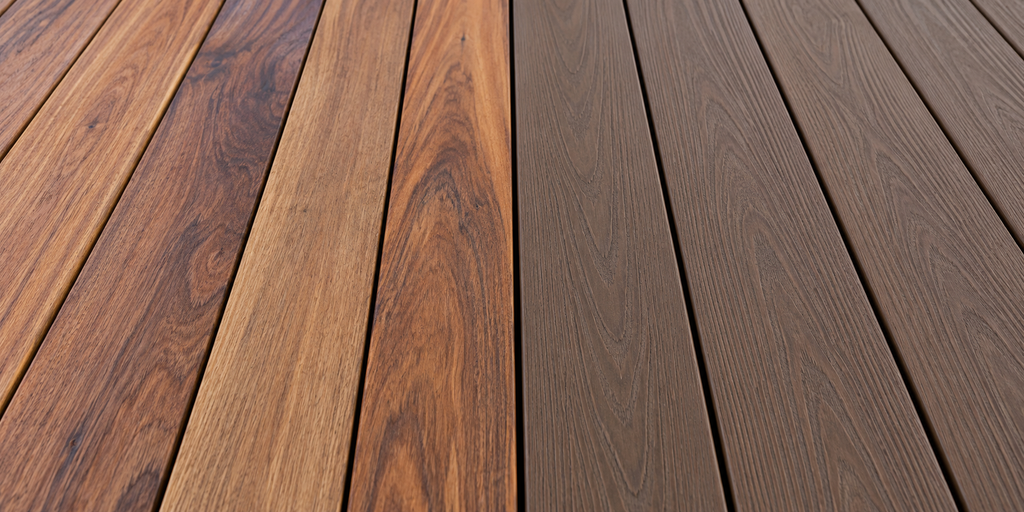
Timber Decking: The Natural Choice
The biggest attraction of timber is simple: it’s real timber.
Products such as Spotted Gum, Blackbutt and Merbau provide natural variation in colour and grain that manufactured boards try to reproduce but cannot completely replicate.
Timber can also offer a lower initial material cost than many premium composite and PVC products, although the actual installed cost depends on the timber species, deck design and construction requirements.
Australian hardwoods such as Spotted Gum and Blackbutt can provide durable decking when the appropriate timber is selected, correctly installed and maintained. Their performance depends on the species, exposure, drainage and construction details.
The compromise is maintenance.
An exposed timber deck needs regular cleaning and recoating if you want to maintain its colour and finish. The required interval depends on the timber, coating system, exposure and manufacturer’s instructions. A deck exposed to strong Sydney sun and weather may require attention more frequently than one protected beneath a patio roof.
And maintenance isn’t just the cost of a tin of decking oil. Once the deck has a dining table, lounge, BBQ and other furniture on it, everything needs to be moved so the deck can be properly cleaned, prepared and recoated.
That needs to be considered before choosing timber—not five years afterwards.
What About Composite Decking?
Composite decking typically combines wood fibre with polymers and is designed to provide the appearance of timber with considerably less routine finishing.
One misconception we regularly hear is that composite decking doesn’t scratch or get damaged.
It can.
A deck is a working surface. Furniture gets moved, BBQs are used, children play on it and things get dropped. Timber, composite and PVC can all be marked or damaged.
The important distinction is that performance varies significantly between products. The composition of the board, protective cap, manufacturing quality and warranty all matter.
The same applies to fading. No homeowner should assume every composite board will perform identically simply because they are all called composite. Australian suppliers such as NewTechWood offer limited residential warranties with specified conditions for issues including staining and fading. Always check the warranty document for the exact product supplied in Australia.
Composite still requires cleaning, but it generally eliminates the sanding, oiling and recoating cycle associated with maintaining the appearance of a timber deck.
For homeowners who don’t want to spend their weekends maintaining decking, that can be a major advantage.
Does Composite Decking Get Hot?
This deserves particular attention in Sydney.
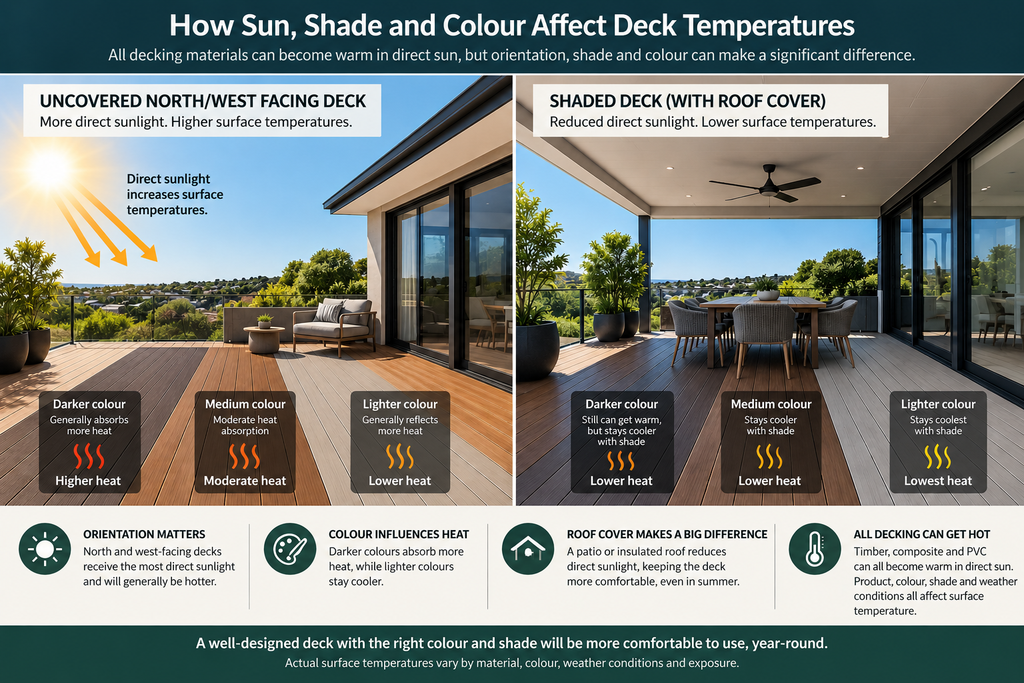
Yes, composite decking can become hot in direct summer sun—but so can other decking materials.
Colour, exposure and the particular product all affect surface temperature. Darker boards generally absorb more solar energy, which is why colour selection becomes important on an uncovered north- or west-facing deck.
It’s also outdated to assume every composite product performs the same way.
Some manufacturers offer decking designed to reduce surface heat build-up compared with their conventional ranges. These are product-specific claims, not a guarantee that a deck will remain cool in direct sunlight. The colour, location and amount of shade still matter.
For a deck receiving substantial Sydney summer sun, we would therefore consider the specific product, colour and orientation, rather than rejecting an entire category of decking because ‘composite gets hot’.
Don’t Forget PVC Decking
PVC is worth separating from traditional wood-plastic composite decking.
PVC decking contains no wood fibre. That gives premium PVC products very high resistance to moisture and removes the potential for the wood component itself to absorb moisture.
That can make PVC particularly interesting for exposed and moisture-prone applications.
Premium PVC products may also offer advantages in surface performance, colour retention and warranty coverage, although these vary between manufacturers. TimberTech markets Advanced PVC decking in Australia, but homeowners should check the warranty documentation supplied for their specific product and Australian purchase rather than relying on overseas warranty information.
That does not mean every PVC board is automatically better than every composite board. Quality composites can also offer substantial warranty protection, depending on the product and its Australian warranty conditions.
The useful lesson for homeowners is to compare actual products rather than just material labels.
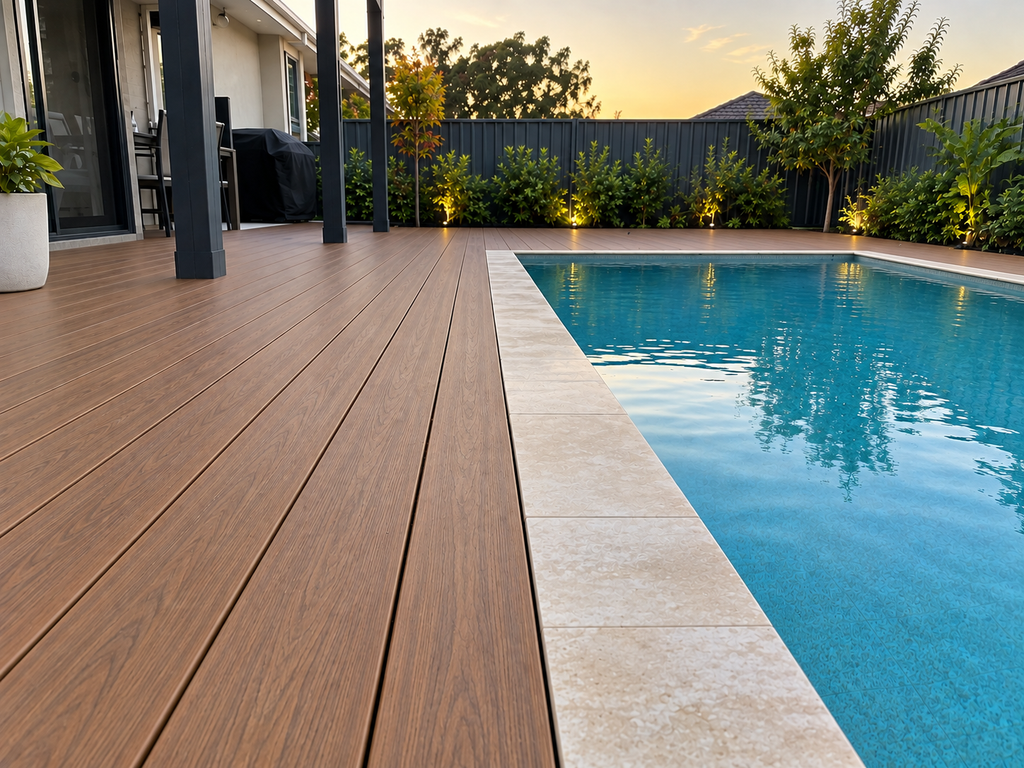
What Works Around a Pool?
Pool decks place different demands on decking.
There is more water, more barefoot traffic and greater potential for the surface to be wet. Drainage, ventilation and the suitability of the framing and fixings need to be considered when designing a poolside deck.
Slip resistance should therefore be considered when selecting a board, but it needs to be checked against the specific product’s tested rating and the requirements applying to the project, rather than assuming all composite decking is automatically suitable.
Where a manufacturer provides Australian slip-resistance test results, these should be checked for the exact board and finish and assessed against the requirements applying to the project. For these areas, we look at the complete system: board selection, substructure, drainage, fixings and the surrounding pool environment.
Timber, Composite or PVC: Which Should You Choose?
Start with your priorities.
If the natural variation and feel of genuine timber matters most to you—and you’re comfortable with ongoing maintenance—hardwood decking can be an excellent choice.
If reducing maintenance is a major priority, a quality composite deserves serious consideration.
If you’re looking for particularly strong moisture resistance, long warranty options or certain performance characteristics, premium PVC may also be worth comparing.
Then look at the site.
How much direct sun will the deck receive? Is it covered? Is it beside a pool? What colour suits the house? How much maintenance are you realistically prepared to undertake? And how long do you expect the deck to remain part of the home?
Think Beyond the Price You Pay Today
This is probably the most important part of the decision.
A deck isn’t something most homeowners expect to replace in a few years. Properly designed, constructed and maintained, it is a long-term part of the home.
So don’t compare materials using the initial price alone.
Think about what owning that deck will involve over the next 10, 20 or more years.
A lower-cost timber option may make perfect sense for someone who loves natural hardwood and doesn’t mind maintaining it. Another homeowner may happily spend more initially to reduce the amount of ongoing maintenance.
Neither decision is wrong.
The aim is to understand the compromises before the deck is built.
Choosing Decking for Your Sydney Home
At Proline Outdoor & Decking, we don’t start with a preferred decking product and try to make it fit every project.
We start by asking how you want to use the space.
From there, we look at your preferred appearance, budget, maintenance expectations, sun exposure, surrounding environment and the performance you need from the deck. We can then compare suitable timber, composite and PVC options and help you make an informed decision.
If you’re planning a new deck in Greater Sydney and aren’t sure which material suits your home, contact Proline Outdoor & Decking to discuss your project and compare the options before you commit to a product.
Disclaimer: The information in this article is provided for general information only and should not be considered professional, legal, planning, engineering or building advice. Requirements can vary depending on your property, location and individual project. Always confirm the requirements that apply to your circumstances with the relevant authority or appropriately qualified professional.